Xylem and Phloem are two major tissues present in the vascular plants. xylem transports water and minerals from root steam and leaves and phloem transports sugar and other organic nutrients to sink tissues.
In this article, we will learn more about what is xylem tissue, what is phloem tissue and key differences between xylem and phloem.
Definition of Xylem
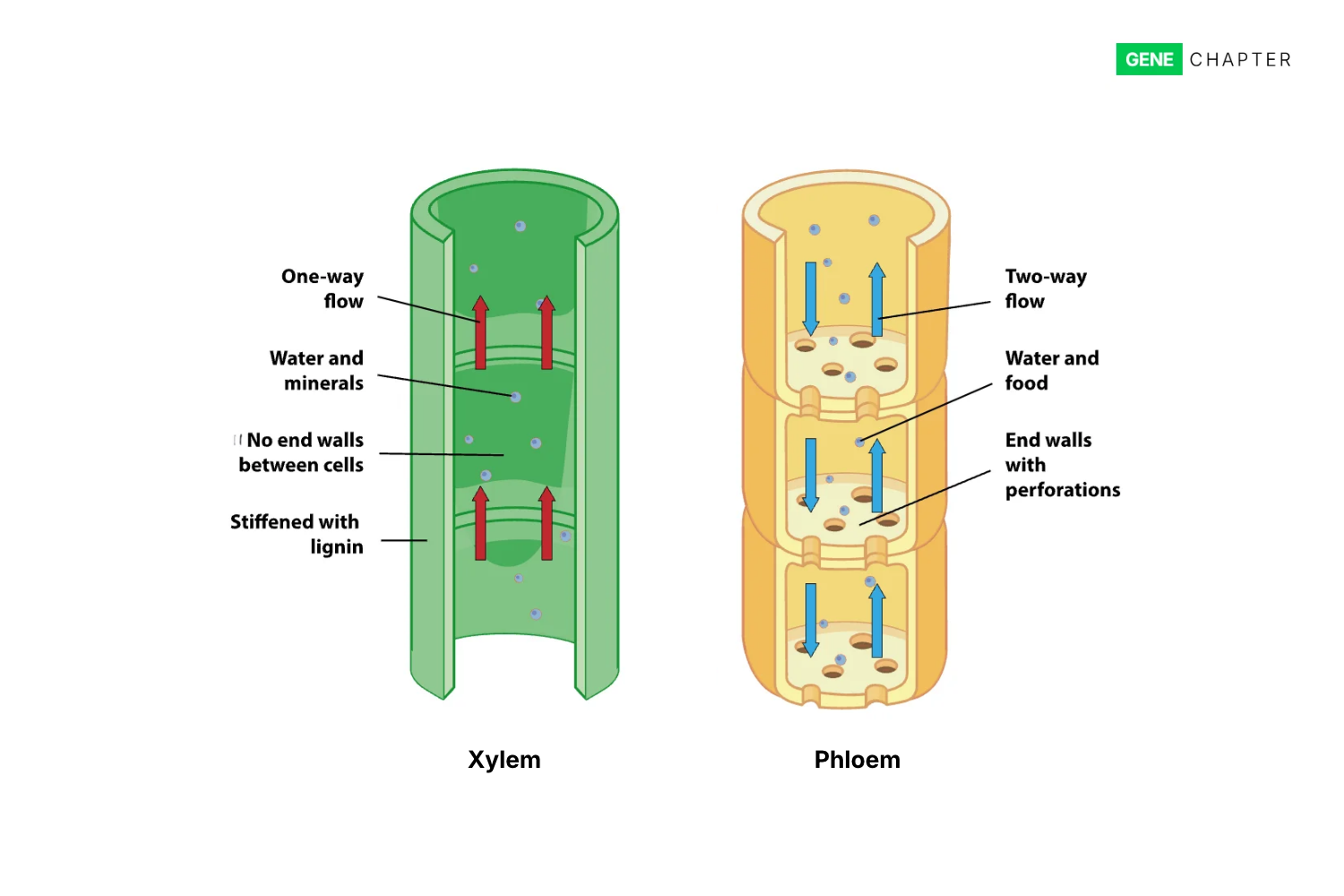
Xylem is the specialized tissue found in the vascular plants, this specialized tissue transports water and minerals from the soil to steam and leaves. Xylem also provides mechanical strength and storage.
The term xylem was introduced by the Swiss botanist Carl Nägeli in 1858. The term xylem is derived from the Ancient Greek word “xylon” meaning wood.
Water and minerals absorbed by the roots moves through the xylem to the leaves. This upward movement of the water is mainly driven by transpiration and cohesive and adhesive properties of water molecules.
Definition of Phloem
Phloem is a complex permanent tissue which acts as the transportation system for soluble organic molecules.
Just like xylem, the term phloem was also introduced by Carl Nägeli in 1858. Phloem word derived from the Greek word “phloios” meaning bark.
Phloem transports soluble organic nutrients such as sugars, amino acids from source tissues to sink tissues ( a part of a plant that uses or stores nutrients transported by the phloem) this process is known as translocation.
Difference Between Xylem and Phloem
Xylem
Phloem
Definition
A vascular tissue that mainly transports water and mineral nutrients through the plant.
A vascular tissue that mainly transports sugars and other organic nutrients through the plant.
Vascular bundles
Occurs together with phloem to form vascular bundles.
Occurs together with xylem to form vascular bundles.
Location
It is located toward the inner side of the vascular bundle.
It is located toward the outer side of the vascular bundle.
Main function
Transports water and mineral nutrients from the roots to the shoots and provides mechanical support.
Transports sugars and other organic substances from source tissues to sink tissues.
Transport Direction
Mainly upward, from roots toward shoots.
Can happens in different directions, depending on the location of sources and sinks.
Main conducting cells
Tracheids and vessel elements.
Sieve tube elements and companion cells.
Nature of conducting cells
Tracheids and vessel elements are dead at maturity.
Sieve tube elements are living but lack a nucleus at maturity; companion cells are living.
Other cell types
Xylem parenchyma and xylem fibres are also present.
Phloem parenchyma and phloem fibres are also present.
Transported substances
Water and dissolved mineral ions.
Mainly sucrose, amino acids, and other organic compounds.
Mechanical support
Provides significant mechanical strength and support to the plant.
Provides comparatively less mechanical support.
Source and sink
Does not normally use the source–sink terminology for its main transport.
Transports substances from sources (such as mature leaves) to sinks (such as roots, fruits, seeds, and growing tissues).