Millon’s test is a qualitative biochemical test for phenolic groups most importantly to detect tyrosine in protein samples. The test is named after Auguste Nicolas Eugene Millon, the French chemist who discovered the reaction.
Millon’s test is not just specific for tyrosine. Other compounds containing suitable phenolic groups may also give positive reactions.
This test is not a confirmation for protein. A positive result does not mean the confirmation of presence of protein.
The test is based on the reaction of the phenolic group with Millon’s reagent, which contains mercury salt in a strong acidic medium. When heated a positive reaction produces a red or pink color precipitate.
Although Millon’s test is commonly used to identify aromatic amino acid tyrosine, it is not a conclusion test for tyrosine, because other compounds containing phenolic groups may also give a positive reaction. Also this is not a confirmation test for detecting protein, because positive test indicates the presence of tyrosine reduces or phenolic groups not protein.
Principle of Millon’s Test
Millon’s test is based on the reaction of a phenolic group of tyrosine with Millon’s reagent under strong acidic conditions. Millon’s reagent is traditionally prepared with mercuric nitrate and mercurous nitrate in nitric acid.
During the test, the phenolic group of tyrosine undergoes undergoes nitration under the strong acidic condition. This reaction introduces nitro groups into the aromatic ring producing nitrated tyrosine derivatives. The resulting nitrated tyrosine derivatives interact with mercury ions present in the reagent. Upon heading these reactions produce a characteristic red or dark pink precipitate, indicating the positive Millon’s test.
In proteins, Million’s reaction is majorly associated with tyrosine because tyrosine is the only amino acid in one of the 20 standard amino acids that contains a phenolic side chain. Therefore, a positive Millon’s test is usually associated with the presence of tyrosine amino acid.
A protein sample may initially produce a white or yellow precipitate with the reagent. Upon heating, the precipitate develops into red or dark pink precipitate. The development of this red or dark pink precipitate is generally considered the positive Millon’s test.
Millon’s Reagent Preparation
Dissolve 160 grams of mercuric nitrate and 160 grams of mercurous nitrate in 400 ml concentrated nitric acid solution. The reagent is then made to 1000 ml by the addition of 600ml distilled water.
Procedure of Millon’s Test
1. Add 2 milliliter of the sample solution or 1% tyrosine solution in a clean dry test tube.
2. Add 2 milliliters of Millon’s reagent. Place the test tubes in the boiling water bath for 2 minutes.
3. The test tubes are heated in a water bath for a few minutes if a red precipitate does not appear immediately.
4. The tubes are then observed for the formation of the colored precipitate.
2. Add 2 milliliters of Millon’s reagent. Place the test tubes in the boiling water bath for 2 minutes.
3. The test tubes are heated in a water bath for a few minutes if a red precipitate does not appear immediately.
4. The tubes are then observed for the formation of the colored precipitate.
Result and Interpretation
A positive result in the Millon’s test is indicated by the formation of red or pink color precipitate. This indicates the presence of tyrosine or tyrosine containing protein.
A negative result in the Millon’s test is indicated by the absence in the formation of red or pink color precipitate. This indicates the absence of tyrosine or tyrosine containing protein.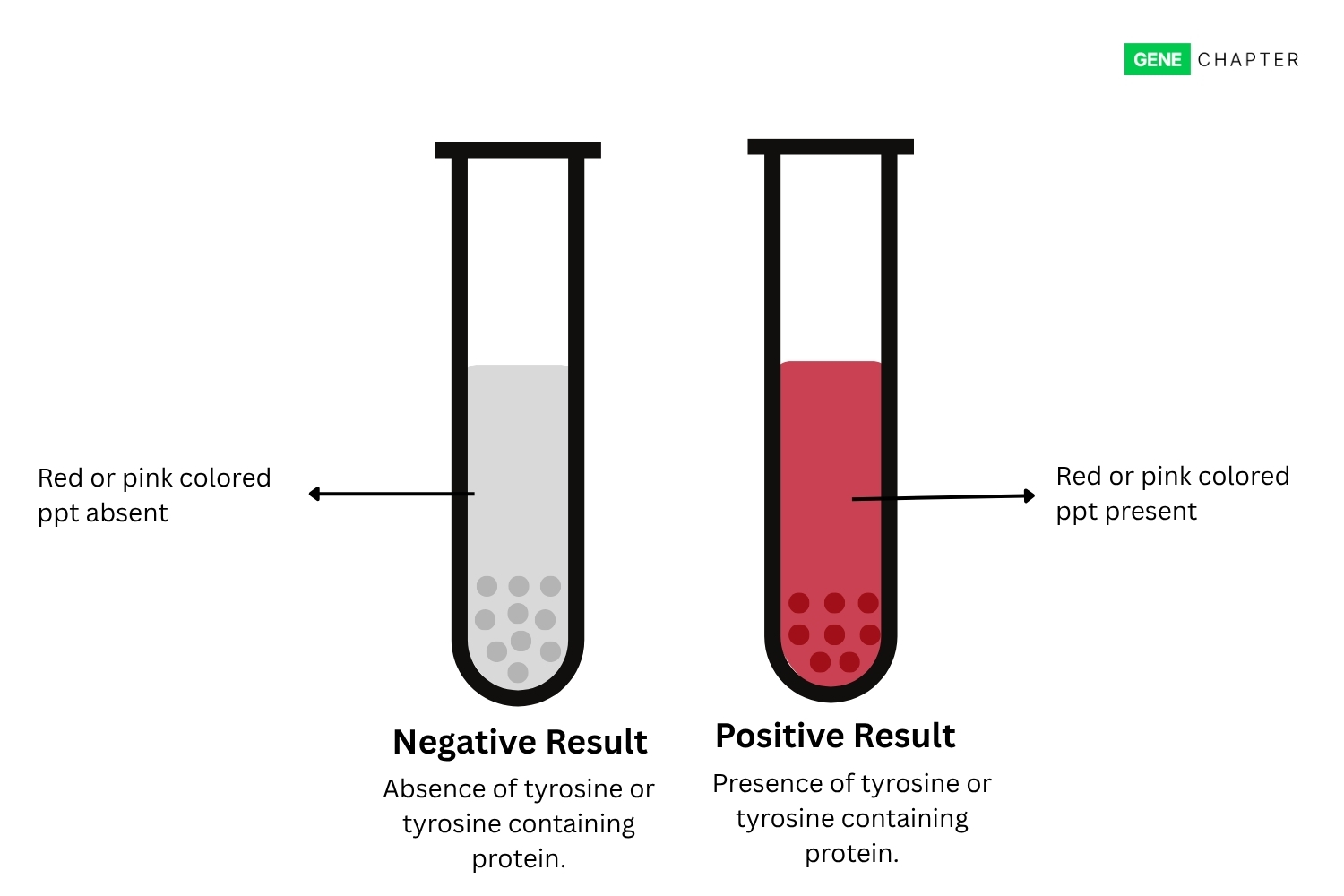
A negative result in the Millon’s test is indicated by the absence in the formation of red or pink color precipitate. This indicates the absence of tyrosine or tyrosine containing protein.
Applications of Millon’s Test
Millon’s test is commonly used to detect the aromatic amino acid tyrosine or tyrosine containing protein sample.
Millon's test can be used to identify compounds containing reactive phenolic groups.
Millon’s test is used as a qualitative biochemical test in labs for the study of amino acids and proteins.
Millon's test can be used to identify compounds containing reactive phenolic groups.
Millon’s test is used as a qualitative biochemical test in labs for the study of amino acids and proteins.
Limitations of Millon’s Test
Millon’s test is not just specific for tyrosine. Other compounds containing suitable phenolic groups may also give positive reactions.
This test is not a confirmation for protein. A positive result does not mean the confirmation of presence of protein.