Seliwanoff’s test is a biochemical test used to differentiate between aldose and ketose sugars. This test is most commonly used to identify fructose (a ketose sugar) from glucose and other aldose sugars.
Seliwanoff’s test is based on the difference in the rate of dehydration of ketose and aldose sugars in the presence of concentrated hydrochloric acid (HCL).
When a carbohydrate sample is heated in the presence of concentrated HCL, the acid promotes the removal of water from the sugar sample. This process is called dehydration. Dehydrated sugar molecule is converted into a furfural derivative.
This process takes place in both aldoses and ketose sugars, but ketosis undergoes this reaction much faster than aldoses.
For ketose sugar eg: fructose, the reaction produces a byproduct called 5-hydromethylfurfural quickly. This compound reacts with resorcinol, which is present in the Seliwanoff’s reagent to form a deep cherry-red color.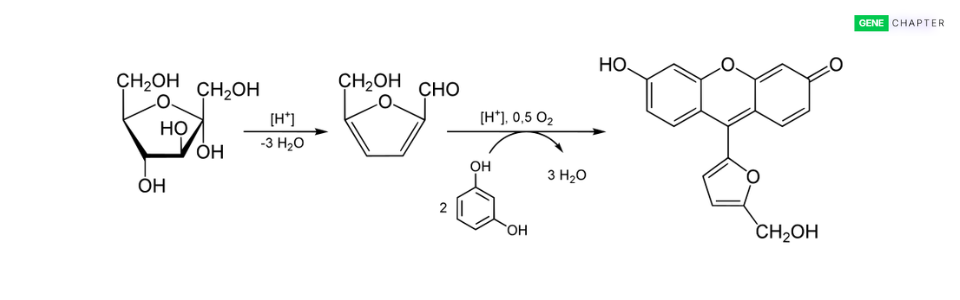
Weigh 50 milligrams of resorcinol and dissolve it in 33 milliliters of concentrated HCL. Add distilled water slowly to make the final volume upto 100 mL. Mix it well to get the Seliwanoff’s reagent.
1. Take two clean and dry test tubes. Add 1 mL of the test sample in one test tube and 1 mL of distilled water in another tube as a blank.
2. Add 2 mL of Seliwanoff’s reagent to each tube.
3. Place both the tubes in a boiling water bath for 1 minute.
4. Observe the color development in the test sample and compare it with the blank.
Principle of Seliwanoff’s test
Seliwanoff’s test is based on the difference in the rate of dehydration of ketose and aldose sugars in the presence of concentrated hydrochloric acid (HCL).
When a carbohydrate sample is heated in the presence of concentrated HCL, the acid promotes the removal of water from the sugar sample. This process is called dehydration. Dehydrated sugar molecule is converted into a furfural derivative.
This process takes place in both aldoses and ketose sugars, but ketosis undergoes this reaction much faster than aldoses.
For ketose sugar eg: fructose, the reaction produces a byproduct called 5-hydromethylfurfural quickly. This compound reacts with resorcinol, which is present in the Seliwanoff’s reagent to form a deep cherry-red color.
Seliwanoff’s Test with Fructose. Image Source: Yikrazuul
Seliwanoff’s Reagent Preparation
Weigh 50 milligrams of resorcinol and dissolve it in 33 milliliters of concentrated HCL. Add distilled water slowly to make the final volume upto 100 mL. Mix it well to get the Seliwanoff’s reagent.
Procedure of Seliwanoff’s test
1. Take two clean and dry test tubes. Add 1 mL of the test sample in one test tube and 1 mL of distilled water in another tube as a blank.
2. Add 2 mL of Seliwanoff’s reagent to each tube.
3. Place both the tubes in a boiling water bath for 1 minute.
4. Observe the color development in the test sample and compare it with the blank.
Result of Seliwanoff’s Test
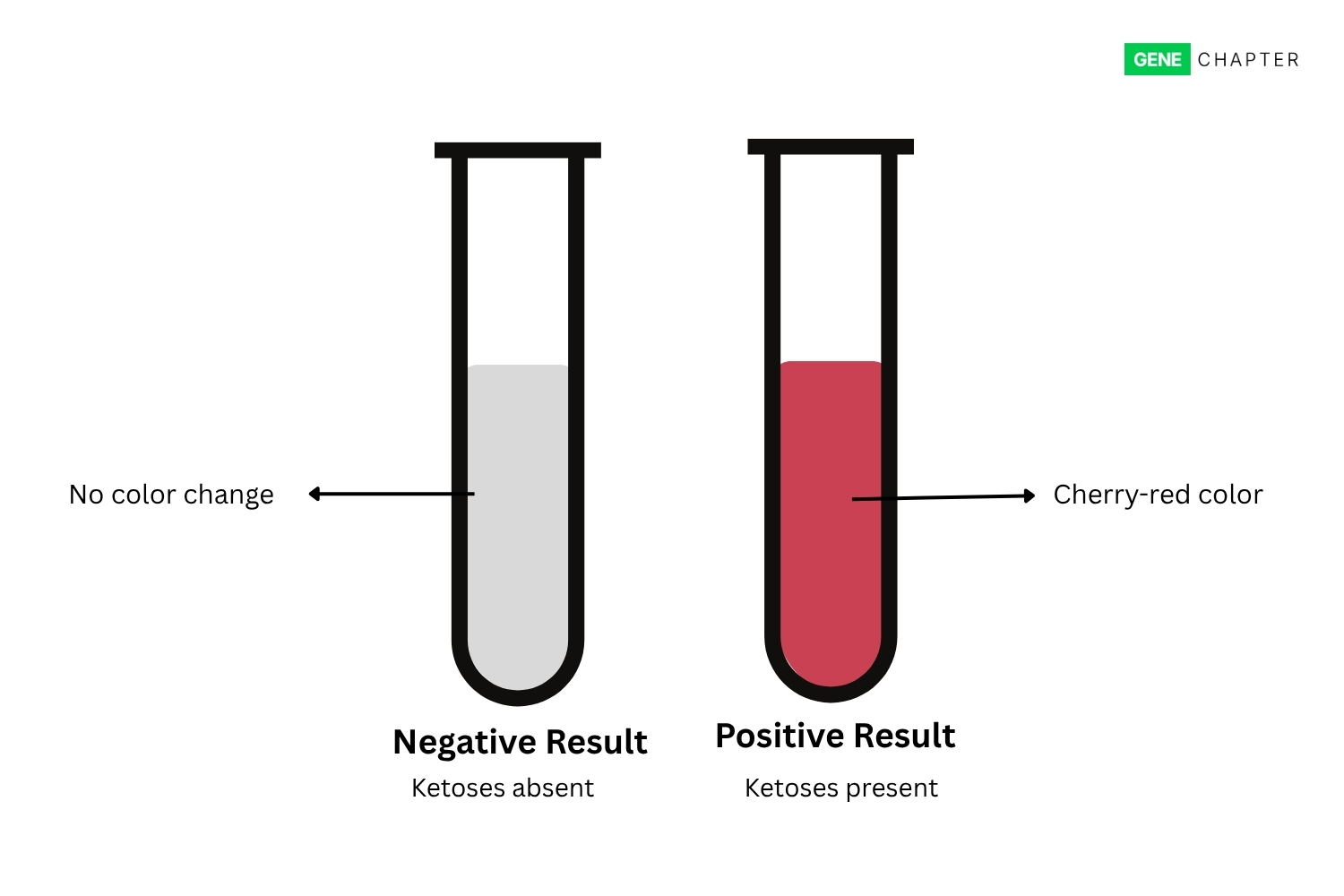
The rapid development of the cherry red color indicates a positive result. Which means the given sample contains ketose sugar.
The absence of cherry-red color indicates the negative result. Which means the given sample does not contain ketose sugar.
Cherry-red color appearing after prolonged heating, may also occur with aldoses. This result should not be considered as a positive result.
Seliwanoff’s Test is used to detect ketose sugars, which produces a rapid cherry-red color.
This helps differentiate between ketose sugars from aldose sugars. Ketose sugars react more rapidly than the aldose sugars.
High concentration of aldose such as glucose might cause interference with color reactions and make false positive reactions.
Seliwanoff’s test is just for identifying ketose sugar or not. It cannot identify any specific ketose.
Sucrose can also give positive results, because during hydrolysis it produces glucose and fructose.
This test is entirely qualitative, so the intensity of the color cannot be used to find the concentration of sugar in the sample.
The absence of cherry-red color indicates the negative result. Which means the given sample does not contain ketose sugar.
Cherry-red color appearing after prolonged heating, may also occur with aldoses. This result should not be considered as a positive result.
Applications of Seliwanoff’s Test
Seliwanoff’s Test is used to detect ketose sugars, which produces a rapid cherry-red color.
This helps differentiate between ketose sugars from aldose sugars. Ketose sugars react more rapidly than the aldose sugars.
Limitations of Seliwanoff’s Test
High concentration of aldose such as glucose might cause interference with color reactions and make false positive reactions.
Seliwanoff’s test is just for identifying ketose sugar or not. It cannot identify any specific ketose.
Sucrose can also give positive results, because during hydrolysis it produces glucose and fructose.
This test is entirely qualitative, so the intensity of the color cannot be used to find the concentration of sugar in the sample.