Difference Between Solar Eclipse and Lunar Eclipse
3 min read
Share:
Solar Eclipse and Lunar Eclipse are two important astronomical events, these events take place based on the position of the sun, earth and moon. Solar Eclipse happens when the moon passes directly between sun and earth blocking all or part of the sunlight, lunar eclipse happens when earth moves directly between sun and moon and blocking sunlight and casting shadow on the moon’s surface.
In this article we will go through what is lunar eclipse, solar eclipse, what are the major differences between solar eclipse and lunar eclipse.
Definition of Solar Eclipse
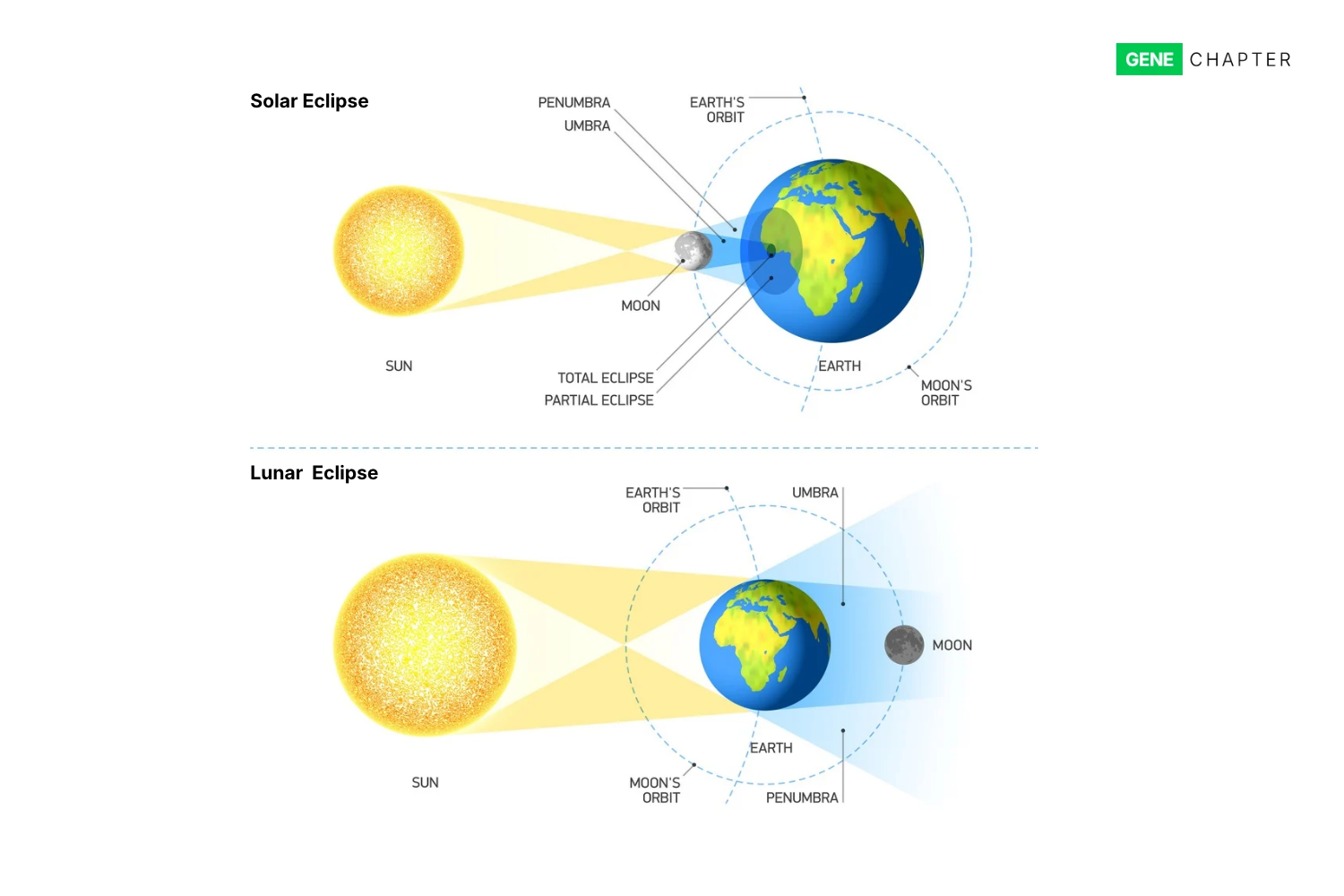
A solar eclipse happens when the Sun, Moon and Earth are directly aligned. The moon blocks the sun’s light and casts a shadow on the earth.
There are four major types of solar eclipse: Total solar eclipse, partial solar eclipse, Annular solar eclipse, and hybrid solar eclipse.
During a total solar eclipse the sun, moon and earth are perfectly aligned and the moon covers the entire sun. During a partial solar eclipse the moon does not pass directly between the sun and earth, so only part of the sun is covered by the moon. During an annular solar eclipse, only the sun's outer ring is visible, it will look like a bright ring around the moon.
Figure 1: Image showing Solar Eclipse and Lunar Eclipse. Reference: annereith.com.
Definition of Lunar Eclipse
A lunar eclipse happens when earth comes between the sun and moon and casts a shadow on the moon.
There are three major types of solar eclipse: total lunar eclipse, particle lunar eclipse and penumbra lunar eclipse.
Total lunar eclipse when the earth comes directly aligned between the sun and moon, the moon is completely covered by earth's shadow. During a total lunar eclipse the moon may look reddish colour, often called a “Blood Moon.”
A partial lunar eclipse is when the earth, moon and sun are less perfectly aligned, a full earth shadow only covers a few parts of the moon surface.
Penumbral lunar eclipse is when the moon passes through the earth’s penumbral layer (Penumbral layer is the lighter part of the earth's shadow). During this kind of eclipse the moon looks slighter dimmer than usual.
Difference Between Solar Eclipse and Lunar Eclipse
Solar Eclipse
Lunar Eclipse
Definition
Happens when the Moon passes between the Sun and Earth, blocking all or part of the Sun’s light.
Happens when the Earth passes between the Sun and Moon, causing Earth’s shadow to fall on the Moon.
Alignment
Sun → Moon → Earth
Sun → Earth → Moon
Moon phase
New Moon
Full Moon
Types
Total, Partial, Annular, and Hybrid
Total, Partial, and Penumbral
Frequency
2–5 solar eclipses can occur worldwide each year.
2–5 lunar eclipses can occur worldwide each year.
Duration
The total duration can last from a few seconds to about 7.5 minutes.
The total duration can last for up to about 1 hour 47 minutes.
Visibility
Visible only from certain regions of Earth.
Visible from a much larger portion of Earth’s night side where the Moon is above the horizon.
Appearance
The Moon appears to cover the Sun, making the sky temporarily darker.
The Moon may appear reddish during a total lunar eclipse.
Eye safety
Directly viewing the Sun can damage the eyes without proper solar viewing protection.