Direct Current (DC) and Alternating Current (AC) are two major types of electric current used in electronic and electrical systems. The main difference between DC and AC current is which direction the electricity flows.
As name implies Alternating Current periodically changes its direction while DC current flows continuously in one direction.
In this article, we will explain about Direct Current, Alternating Current and Difference between Direct Current and Alternating Current.
Direct Current (DC) is the type of electric current flowing consistently in one direction. In Direct Current electrons move in a single direction, from the negative terminal to the positive terminal of a power source.
DC has a very steady flow means it maintains a constant polarity, meaning the voltage is always stable over time. Which makes DC suitable for devices which require stable current supply. Common sources of Direct current are batteries, solar cells.
Alternating current (AC) is an electric current that reverses its direction periodically. Unlike DC which flows only in one direction, AC repeatedly changes in direction.
In AC, current changes their magnitude and polarity periodically. When polarity changes, the direction of the current also changes. This change happens at the fixed rate which is technically called frequency.
In many countries including the USA, India the standard AC has a frequency of 50 Hz which means currently completed 50 cycles per second.
AC is the most commonly used in equipment because it can be easily sent over long distances efficiently which is suitable for factories, homes and electric appliances.
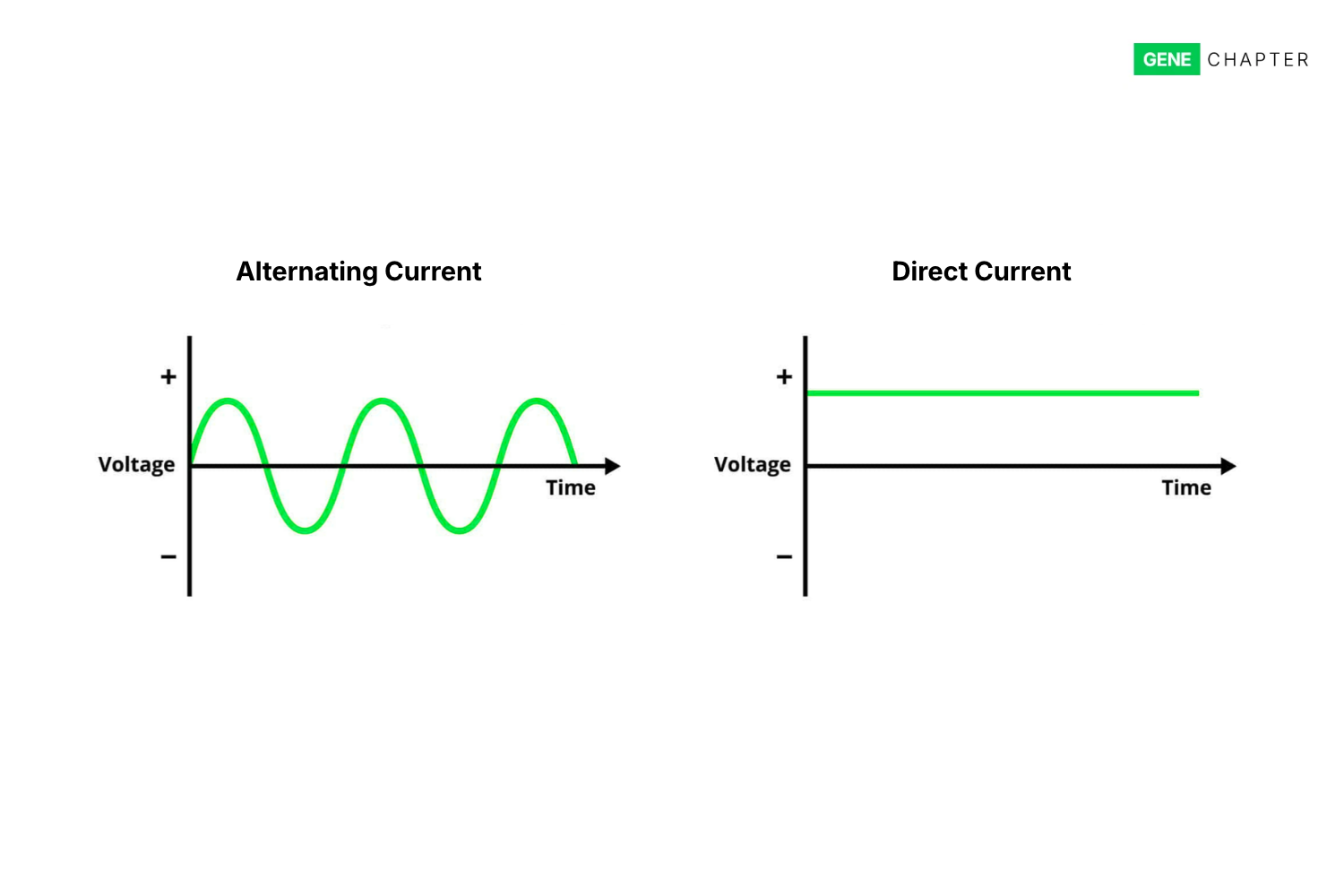
As name implies Alternating Current periodically changes its direction while DC current flows continuously in one direction.
In this article, we will explain about Direct Current, Alternating Current and Difference between Direct Current and Alternating Current.
What is Direct Current
Direct Current (DC) is the type of electric current flowing consistently in one direction. In Direct Current electrons move in a single direction, from the negative terminal to the positive terminal of a power source.
DC has a very steady flow means it maintains a constant polarity, meaning the voltage is always stable over time. Which makes DC suitable for devices which require stable current supply. Common sources of Direct current are batteries, solar cells.
What is Alternating Current
Alternating current (AC) is an electric current that reverses its direction periodically. Unlike DC which flows only in one direction, AC repeatedly changes in direction.
In AC, current changes their magnitude and polarity periodically. When polarity changes, the direction of the current also changes. This change happens at the fixed rate which is technically called frequency.
In many countries including the USA, India the standard AC has a frequency of 50 Hz which means currently completed 50 cycles per second.
AC is the most commonly used in equipment because it can be easily sent over long distances efficiently which is suitable for factories, homes and electric appliances.
Difference between Direct Current and Alternating Current
| Direct Current (DC) | Alternating Current (AC) |
| Direction of flow | |
| Flows in one direction. | Periodically reverses direction. |
| Polarity | |
| Constant polarity. | Polarity periodically reverses. |
| Magnitude | |
| May remain constant or vary, but does not periodically reverse direction. | Varies periodically with time. |
| Frequency | |
| Steady DC has a frequency of 0 Hz. | Has a specific frequency, commonly 50 Hz or 60 Hz. |
| Waveform | |
| Steady DC is a constant level over time. | Typically a sine wave for common AC power. |
| Transmission | |
| Used in High-Voltage Direct Current systems for specific cases. | Dominant for power transmission and distribution worldwide. |
| Common sources | |
| Batteries, solar cells, fuel cells. | Generators (alternators) and power grids. |
| Applications | |
| Batteries, electronic circuits, computers, and portable devices. | Homes, offices, industries, and electrical appliances. |