The microscopic world is filled with a wide variety of living organisms. Bacteria and Amoeba are two of them but they have different cell structure and way of living. Bacteria's are simple single-celled prokaryotes and Amoeba are single-celled eukaryotes with well defined nuclei.
Understanding the difference between bacteria and amoeba’s cell structure, organization, nutrition, movement and reproduction helps us understand more about these organisms.
In this article, we will take a brief look at what bacteria is, what amoeba is and the difference between Bacteria and Amoeba.
Bacteria's are single celled organisms. Bacteria's are most commonly found almost everywhere around the world and these are very important for the planet's ecosystem. They live on your skin, gut, airways, digestive system and reproductive system.
Bacteria do not have membrane bound cell organelles and they lack a true nucleus. Hence they are grouped under the domain “Prokaryota”. The word bacterium is derived from the Greek word “backerion” meaning “cane” as the first bacteria observed were bacilli (rod-like shape).
Amoeba are single-celled microorganisms which move by shape shifting. Amoeba’s are commonly found in water bodies such as ponds, lakes and very slow-moving rivers. Amoeba are part of the Protist kingdom and they are generally characterized by their irregular shape and unique method of movement.
Even though it is a single-celled organism, Amoeba is classified as a eukaryotic organism because its single cell has a true nucleus and membrane-bound organelles. Its genetic material DNA is enclosed within a well-defined nucleus, while specialized organelles carry out different functions inside the cell.
Understanding the difference between bacteria and amoeba’s cell structure, organization, nutrition, movement and reproduction helps us understand more about these organisms.
In this article, we will take a brief look at what bacteria is, what amoeba is and the difference between Bacteria and Amoeba.
What is Bacteria?
Bacteria's are single celled organisms. Bacteria's are most commonly found almost everywhere around the world and these are very important for the planet's ecosystem. They live on your skin, gut, airways, digestive system and reproductive system.
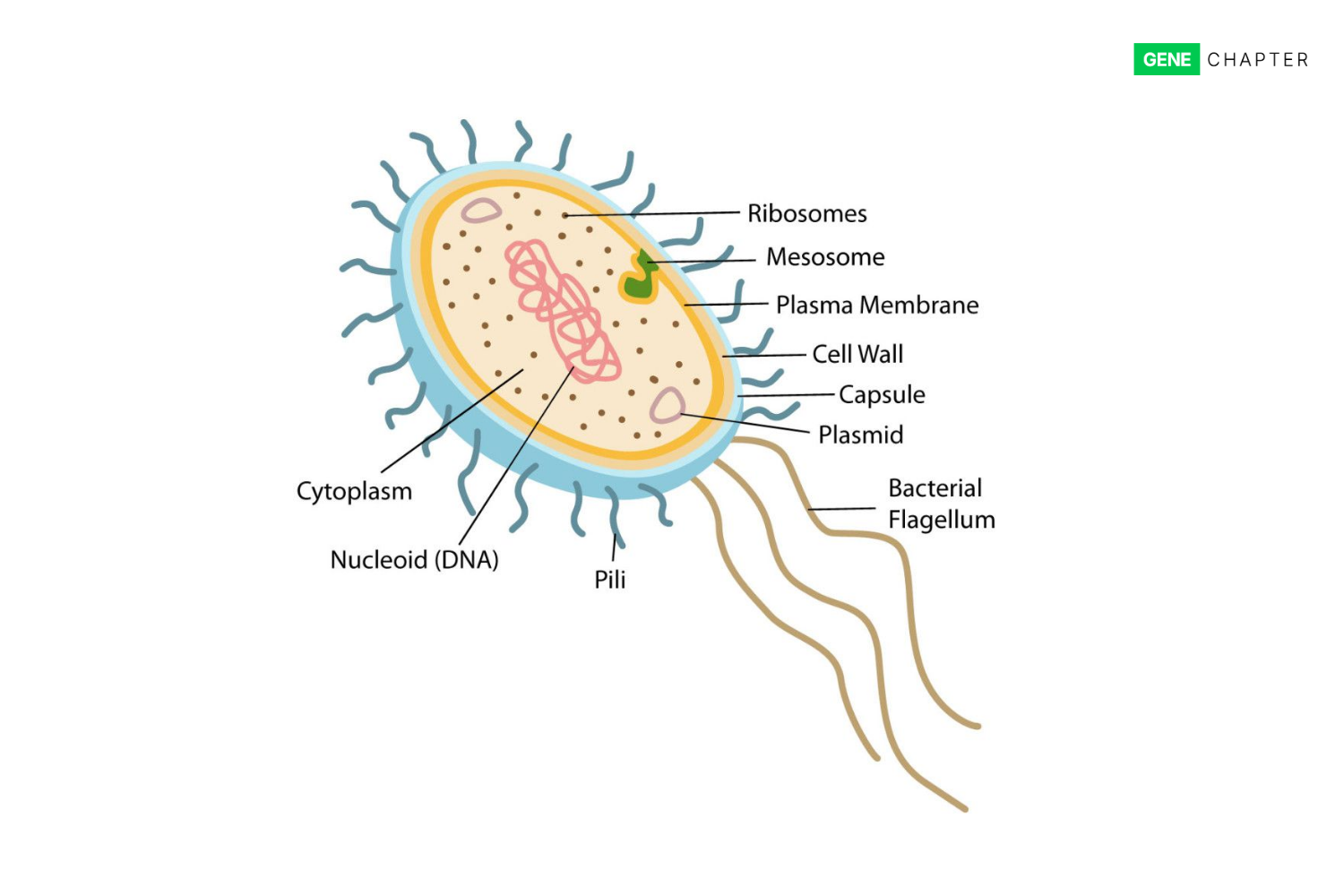
Bacteria do not have membrane bound cell organelles and they lack a true nucleus. Hence they are grouped under the domain “Prokaryota”. The word bacterium is derived from the Greek word “backerion” meaning “cane” as the first bacteria observed were bacilli (rod-like shape).
Figure 1: Image showing labelled diagram of Bacteria. Image Source: plantlet.org
What is Amoeba?
Amoeba are single-celled microorganisms which move by shape shifting. Amoeba’s are commonly found in water bodies such as ponds, lakes and very slow-moving rivers. Amoeba are part of the Protist kingdom and they are generally characterized by their irregular shape and unique method of movement.
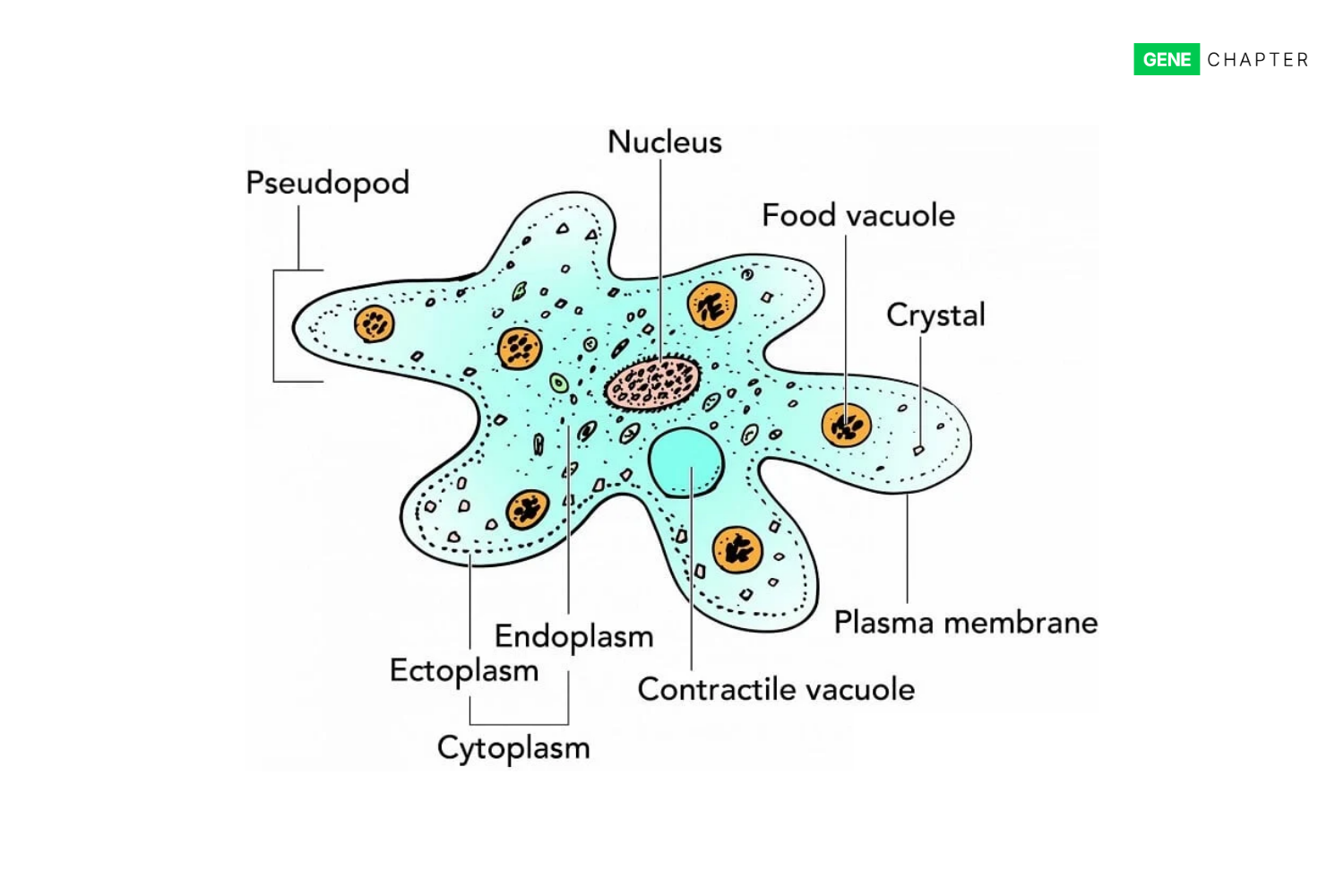
Even though it is a single-celled organism, Amoeba is classified as a eukaryotic organism because its single cell has a true nucleus and membrane-bound organelles. Its genetic material DNA is enclosed within a well-defined nucleus, while specialized organelles carry out different functions inside the cell.
Figure 2: Image showing labelled diagram of Amoeba. Image Source: rsscience.com
Differences between Bacteria and Amoeba
| Bacteria | Amoeba |
| Type of Organism | |
| A single-celled prokaryotic organism. | A single-celled eukaryotic organism. |
| Cell Structure | |
| Simple cell structure and does not have a true nucleus or membrane-bound organelles. | Has a more complex cell structure with a true nucleus and membrane-bound organelles. |
| Nucleus | |
| Does not have a membrane-bound nucleus. | Has a distinct, membrane-bound nucleus that contains its DNA. |
| Cell Wall | |
| Most bacteria have a cell wall outside the cell membrane. | Does not have a cell wall. |
| Shape | |
| Different shapes - spherical (cocci), rod-shaped (bacilli), and spiral-shaped forms. | Has no fixed shape and continuously changes its shape. |
| Size | |
| Usually about 0.5–5 µm in size, varies among species. | Ranges from about 10–1000 µm, depending on the species. |
| Movement | |
| Some bacteria move using structures such as flagella, while others are non-motile. | Moves by extending temporary projections called pseudopodia or “false feet.” |
| Mode of Nutrition | |
| May be autotrophic or heterotrophic, depending on the species. | Mainly heterotrophic and obtains food by engulfing food particles. |
| Feeding | |
| Many bacteria absorb nutrients from their surroundings. | Engulfs food particles using pseudopodia. |
| Digestion | |
| Nutrients are broken down through biochemical processes within the cell. | Digestion takes place inside food vacuoles. |
| Respiration | |
| Aerobic or anaerobic respiration, depending on the species. | Exchanges gases mainly by diffusion through the cell membrane. |
| Excretion | |
| Waste products are generally released through the cell membrane. | Waste products are released through the cell membrane; excess water is removed by the contractile vacuole. |
| Reproduction | |
| Mainly reproduces asexually by binary fission. | Mainly reproduces asexually by binary fission. |
| Habitat | |
| Found almost everywhere, including soil, water, air, and inside living organisms. | Commonly found in freshwater and moist environments. |