The nucleus is one of the most important structures in eukaryotic cells and sometimes it is called the control center or brain of the cell. Nucleus contains the genetic material (usually DNA) and uses DNA to regulate almost all forms of cellular activities like making protein, cell division.
The nucleus was first discovered and named by the Scottish botanist and paleobotanist Robert Brown in the year 1831.
The nucleus (plural: nuclei) is a double-membrane bound organelle found only in eukaryotic cells. Nucleus contains the genetic material called DNA and using this it controls cell activity, growth, reproduction, gene expression and much more.
The word nucleus comes from the Latin word which translates to “kernel of a nut” or “core”. The name was introduced by Robert Brown.
Apart from this Nucleus is the defining feature of the eukaryotic cells, because bacterias, fungi’s and other prokaryotes have defined nucleus. Their genetic material is contained in the organelle called nucleoid.
The nucleus was first discovered and named by the Scottish botanist and paleobotanist Robert Brown in the year 1831.
Definition of Nucleus
The nucleus (plural: nuclei) is a double-membrane bound organelle found only in eukaryotic cells. Nucleus contains the genetic material called DNA and using this it controls cell activity, growth, reproduction, gene expression and much more.
The word nucleus comes from the Latin word which translates to “kernel of a nut” or “core”. The name was introduced by Robert Brown.
Apart from this Nucleus is the defining feature of the eukaryotic cells, because bacterias, fungi’s and other prokaryotes have defined nucleus. Their genetic material is contained in the organelle called nucleoid.
However, few eukaryotic cells also do have nucleus. For example: Red Blood Cells (RBC) lose their nucleus as they are maturing.
The nucleus is the spherical organelle often found in the center of the cell, it is usually 5-10 µm in diameter. It is made up of the following components;
Structure of Nucleus
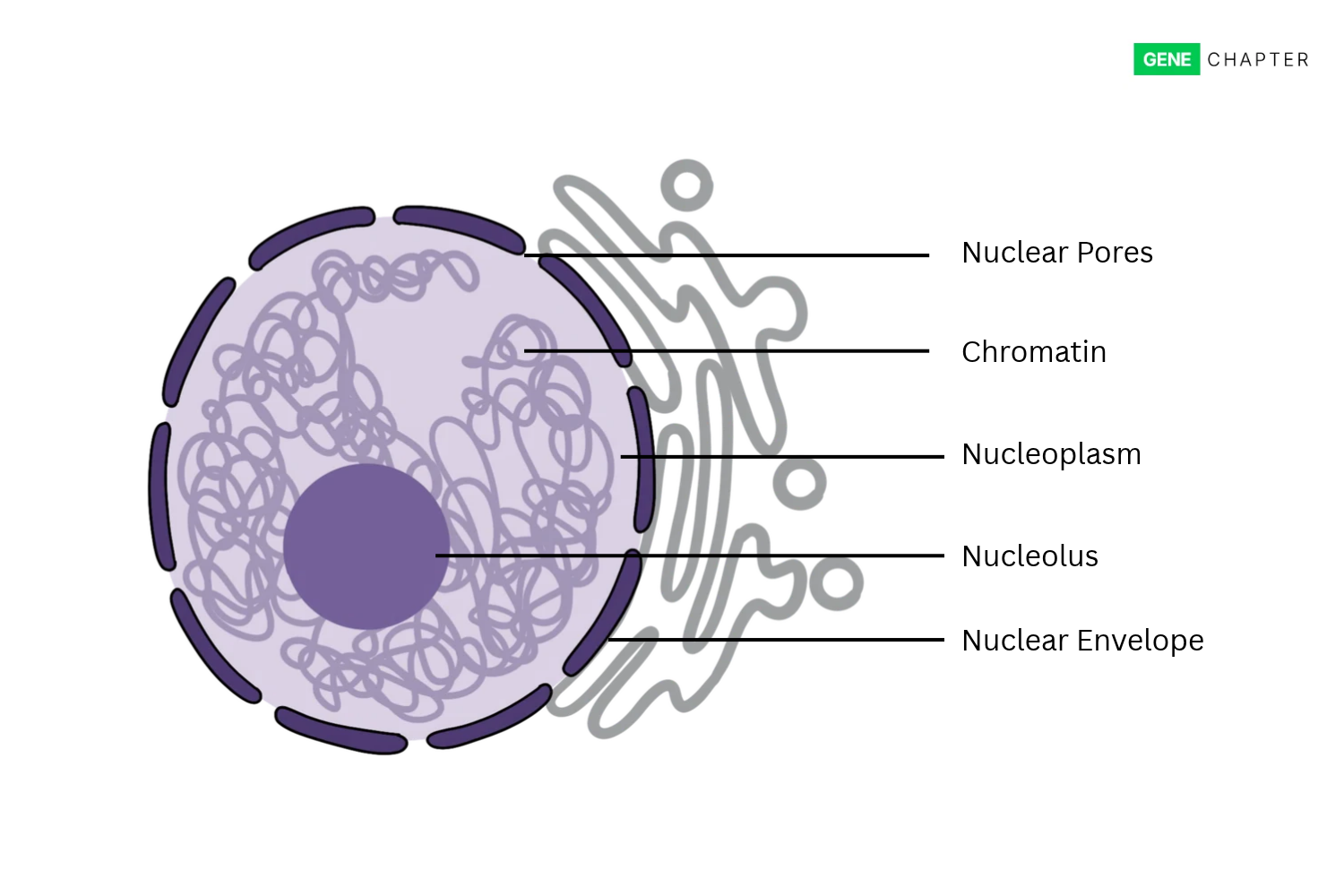
The nucleus is the spherical organelle often found in the center of the cell, it is usually 5-10 µm in diameter. It is made up of the following components;
1. Nuclear Envelope
A double membrane structure (inner membrane and outer membrane) and encloses the nucleus and separates it from the cytoplasm.
Outer membrane: It faces the cytoplasm (outer layer) and it is physically attached with the Endoplasmic Reticulum.
Inner membrane: Faces the nucleoplasm side (inner layer) and it carries the protein that anchors nuclear lamina and chromatin.
Perinuclear space: It is the narrow gap between inner membrane and outer membrane. The space between these membranes are about 20-40 nano meters.
2. Nuclear Pores
Nuclear pores are an opening where the inner membrane and outer membrane fuse together. Each pore is formed by a large protein assembly known as the nuclear pore complex, which is made up of proteins known as nucleoporins. In the nuclear pores smaller molecules can diffuse without any restrictions but for larger molecules it needs transport signals and carrier proteins.
3. Nuclear lamina
The nuclear lamina is a complex protein mesh attached to the inner nuclear membrane. Nuclear lamina forms part of the nuclear skeletal network (karyoskeleton) anchoring the chromatin and nuclear envelope.
4. Nucleoplasm
The nucleoplasm is a viscous liquid that fills the nucleus, just like the cytoplasm of the cell. It contains dissolved salts, ions, free nucleotides (the building blocks of DNA and RNA) and enzymes (needed for gene transcription and translation) and proteins.
5. Chromatin
Chromatin is a negatively charged polymer composed of DNA, histones, and various nonhistone proteins. Chromatin's fundamental role is to package the genetic material in an efficient and compact form that allows very large DNA molecules to fit inside the cell nucleus.
6. Nucleolus
Nucleolus is a dark and dense component inside the nucleus and it has no membrane. The function of the nucleolus is to make ribosomal RNA (rRNA) and combine it with proteins, this makes ribosomal subunits. These subunits leave the nucleus and join together to form ribosomes and later which make proteins.
1. Nucleus contains DNA which carries the genetic information which are essential for the cell development, regulation and multiplication.
2. Nucleus plays as the control center of the entire cell and plays a very important role in the cell's activities.
3. DNA present inside the nucleus contains an instruction for synthesizing protein, which are very essential for growth and functioning of the cell.
4. During cell division nucleus controls the process and distribution of DNA, which ensures the new cell receives its genetic material.
5. Nucleolus present inside the nucleus produces a ribosomal RNA commonly known as rRNA and helps form ribosome subunits, which later joins together and produce protein.
A double membrane structure (inner membrane and outer membrane) and encloses the nucleus and separates it from the cytoplasm.
Outer membrane: It faces the cytoplasm (outer layer) and it is physically attached with the Endoplasmic Reticulum.
Inner membrane: Faces the nucleoplasm side (inner layer) and it carries the protein that anchors nuclear lamina and chromatin.
Perinuclear space: It is the narrow gap between inner membrane and outer membrane. The space between these membranes are about 20-40 nano meters.
2. Nuclear Pores
Nuclear pores are an opening where the inner membrane and outer membrane fuse together. Each pore is formed by a large protein assembly known as the nuclear pore complex, which is made up of proteins known as nucleoporins. In the nuclear pores smaller molecules can diffuse without any restrictions but for larger molecules it needs transport signals and carrier proteins.
3. Nuclear lamina
The nuclear lamina is a complex protein mesh attached to the inner nuclear membrane. Nuclear lamina forms part of the nuclear skeletal network (karyoskeleton) anchoring the chromatin and nuclear envelope.
4. Nucleoplasm
The nucleoplasm is a viscous liquid that fills the nucleus, just like the cytoplasm of the cell. It contains dissolved salts, ions, free nucleotides (the building blocks of DNA and RNA) and enzymes (needed for gene transcription and translation) and proteins.
5. Chromatin
Chromatin is a negatively charged polymer composed of DNA, histones, and various nonhistone proteins. Chromatin's fundamental role is to package the genetic material in an efficient and compact form that allows very large DNA molecules to fit inside the cell nucleus.
6. Nucleolus
Nucleolus is a dark and dense component inside the nucleus and it has no membrane. The function of the nucleolus is to make ribosomal RNA (rRNA) and combine it with proteins, this makes ribosomal subunits. These subunits leave the nucleus and join together to form ribosomes and later which make proteins.
Function of Nucleus
1. Nucleus contains DNA which carries the genetic information which are essential for the cell development, regulation and multiplication.
2. Nucleus plays as the control center of the entire cell and plays a very important role in the cell's activities.
3. DNA present inside the nucleus contains an instruction for synthesizing protein, which are very essential for growth and functioning of the cell.
4. During cell division nucleus controls the process and distribution of DNA, which ensures the new cell receives its genetic material.
5. Nucleolus present inside the nucleus produces a ribosomal RNA commonly known as rRNA and helps form ribosome subunits, which later joins together and produce protein.